Security Guard Blues
No. 41
Hi there:
I hope this email finds you and loved ones in good health and spirits.
First and foremost, as a native Hong Konger, I’d be remiss to not mention the horrific fire that tore through seven of Wang Fuk Court’s eight apartment blocks in northern Tai Po District on Nov. 26. The toll as of this writing: 160 dead and 79 injured. Some 4,200 people were displaced.
Also, in the wee hours of Nov. 27, in Kunming, where I currently live, a high-speed train in testing ran into a crew of construction workers, killing 11 and injuring 2.
Last but not least, on a personal note, on Sept. 21, an old family friend and one of Gushi’s early boosters, Yee Lee, passed away in his sleep. A father of two children and two step-children, he was only 51.
This issue is dedicated to Yee and the victims and survivors in Hong Kong and Kunming.
In this edition, I feature my first-ever piece from Ourlife, a division of Chinese streaming giant iQIYI. Ourlife was launched in June 2024 by the industrious Shen Yanni and her team, formerly of Netease’s The Livings. This nuanced profile of residential security guards, written by their sympathetic manager, was first published in Chinese on Nov. 8, 2024. All names are aliases.
Feel free to share your thoughts by dropping me a line at mlee921@gmail.com. Apparently I’ve been having some mail-forwarding issues. Apologies if I missed your messages from before.
Take care and see you soon. Happy holidays to those in the West.
—ML
Human Punching Bag: The Trials and Tribulations of Residential Security Guards
By Wu Jinda
Edited by Wu Yao
1.
After the real-estate industry blew up, most major property management companies adjusted, regrouped and reformed. As a property management professional, I naturally was not immune to the fallout. Three months after the collapse, I decided to settle down at a small firm.
The company reported directly to a developer, which was an out-of-town outfit that had just begun to make a name for itself locally when the depression struck. It was unable to finish and deliver its first project on time. After a year’s delay, caving to pressure from all sides, the developer could only hand over its new units reluctantly and thus set up a property management company to cope with the backlash.
Before starting my position, my interviewers kept hinting that the complex I’d be managing was a delayed project. I refused to believe I was cursed. Even if that were the case, I thought to myself, wouldn’t we just follow normal property management protocol—initially assist with unit handovers and after owners confirmed receipt, start taking over day-to-day property management? I was already a veteran of the industry of several years. I had these tasks down cold.
The residential complex I managed was handing over new units the day I started. I was stopped by a group of security guards at the entrance. They asked the purpose of my visit. I explained politely: “I interviewed here a few days ago. I’m here to start my job.”
A sharp, slender young man—I suspect their team leader—gestured to let me in. After I entered, I overheard the guards whispering: “It’s the new manager. I saw him a few days ago.” Only later did I realize they were waiting to watch me fail. Before me, the company had already gone through three managers.
When I finally started, I realized that my interviewers weren’t bluffing. On the first day of the delayed handover, the owners staged a major protest based on the delay itself, allegedly shoddy renovation and purported failure to connect the heating system. To stop the owners from congregating, the developer switched to a scheme of handover by appointment. Owners without an appointment and unrelated personnel were banned from the residential complex. The developer also hired extra security. When I started my job, I had 17 security guards on site reporting to me. During that period, my job was extremely difficult and infuriating.
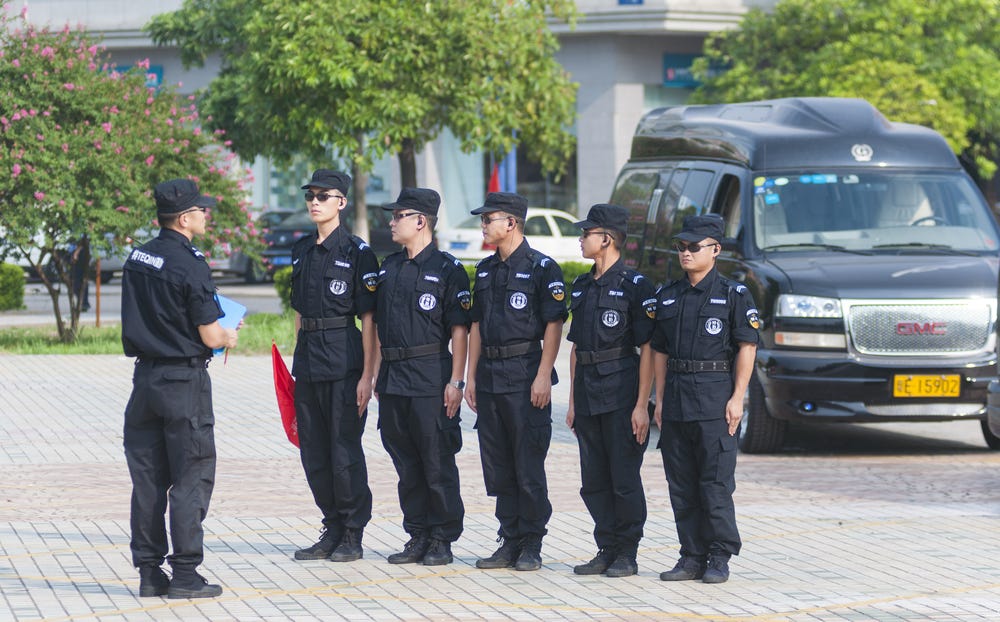
Captain Qi was the team leader who let me onto the premises. Every day he had to form a human wall with his team, setting up in front of the traffic gate at the entrance to our complex as they blocked furious owners who were intent on barging in. Under the scorching sun, the face of every security guard was darkly tanned. The strong sunlight had them squinting and sweat rained down both sides of their cheeks. They didn’t have free hands to wipe away the sweat. The guards looked like they had nothing to lose. In the eyes of the owners, they probably came off as ruthless.
Bound by the directive of “no violence, no talking back and keep unrelated personnel out at all costs,” the guards steadfastly guarded the space that separated the owners from their new homes, arms linked, shoulders pressed, coping simultaneously with angry owners, curious bystanders and probing journalists. Amid the physical contact, the pushing and shoving, the insults, hollering and personal attacks, conflicts small and large were a mere trigger away. Police officers came and went. Officer Sun, who oversaw our neighborhood, approached me several times a day. “Is this over with yet?” he’d complain. All I could do was smile apologetically and hand him a complimentary bottle of water. Meanwhile, I had to head down to the police station almost daily to attend mediation sessions or give written statements.
**
Out of the blue one day, the developer announced it was halting the handover of new units. Owners who had not yet signed off on their apartments were banned from entering the complex. That very morning, I was at the police station again, giving a statement. A family of five—two men, two women and a child—had breached our cordon with a kamikaze approach. During the conflict, a woman from the family injured her knee, which led to bleeding.
By the time I arrived, the commotion had ended. I invited the family to a nearby conference room, so I could calm them down. When the police arrived, the family asked us to explain our actions, wondering why they were banned from entering the apartment they had bought, not to mention being beaten by security and having their children spooked.
Captain Qi pled innocent. “Our people couldn’t have possibly attacked them. They tried to barge in with sticks and bricks and injured themselves,” he said.
After a mediation session by police, we ended up paying 200 yuan (US$28) in damages. After getting clearance from my bosses, I had my staff politely show the family the crude, bare-bones, unrenovated unit they had bought. And so we moved on from the episode.
When the dust settled, I reviewed footage of the clash shot by bystanders. After the family of five showed up at the handover center, security guard Chubby clung to the handles of the door with both hands and stalled, holding down fort with the entire might of his body. The guards behind Chubby were no help, hesitant because they were worried about hurting the child in the family. Eventually, Chubby was no match for the the family’s invasion. When the family stormed into the office, the two men threatened my colleagues, one holding a brick and another wielding a meter-long plank, yelling indiscriminately. Captain Qi stepped up and tried to hold them off. The face-off was on the verge of escalation. The footage ended there.
Chubby missed work the day after the incident. Captain Qi told me he suffered a severe wrist injury that resulted in major swelling. When Chubby returned, his attendance was spotty and soon he submitted his resignation. Only then did I find out that he was still a student who was part-timing during summer vacation.
Fast-forward, after multiple changes in handover policy and protocol, the controversy died down gradually. Disgruntled owners took their fight behind-the-scenes while owners who had already taken receipt of their flats accepted the status quo and got ready to move in.
The focus of the management office also gradually shifted from unit handover to daily services.
2.
Prior to winter in 2022, we experienced another severe COVID outbreak. The entrance to our complex became our last line of defense again. We asked our guards to check the movement QR code of every owner that entered. Our company evaluated every guard on this task repeatedly and had their direct supervisor, Manager Niu, do the same again. Failure to do so led to verbal warnings and even monetary fines. Local and neighborhood government officers also went undercover in every complex to test their disease prevention precautions. If loopholes were found, the relevant management companies were bound to be summoned. As the buck passed down the line, security guards naturally were prime targets of outrage.
Given the severity of the outbreak and overall public pressure, it was rare for owners to not comply. They usually showed their movement QR codes voluntarily. But there were exceptions who rudely refused to cooperate. There were those who were upset by the entire property buying process and others who were simply taking their anger out on the guards.
After Chubby left, Manager Niu dispatched “Hubei”—nicknamed thus by his colleagues because he is from Hubei Province. Hubei was a man of few words. He looked visibly decent and honest, probably in his early 20s. Even though the kid had soulless eyes and rarely showed emotion, he was a competent worker who efficiently handled heavy items and trash disposal.
One day, when Hubei was on duty at the main entrance, an owner who typically got along with the property management office didn’t show his movement QR code. Hubei stopped him. The owner barked: “I don’t have a movement code,” turned his head and got ready to leave.
Captain Qi was also present. He patiently explained the latest precautions, but the owner was defiant: “How come I need to be checked returning to my own home?” At that point, I decided to intervene, approaching the owner and saying: “These are extraordinary times. Please be understanding.” The owner was still adamant. He gave me a quick stare and kept on walking.
Suddenly, Hubei erupted. “Do you still want to come home in the future?”
Upon hearing the comment, the owner turned around and geared up for a fight. Before Hubei’s bomb had set in, Captain Qi and I threw our bodies in front of the owner. Glaring, the owner stuck his arm around our bodies toward Hubei and said: “Just try to keep me out. You can bet I will end you. You’re one bold mofo!”
Everyone present approached the owner to calm him down. The owner reluctantly retreated, turning around and muttering insults every other exaggerated step as he entered the complex. Except for the bomb he dropped, Hubei didn’t say anything else during the dispute. His eyes remained vacant, his face expressionless. His head was lowered the entire time and he didn’t move an inch.
After the owner left, Captain Qi kept on lecturing Hubei. I gestured to him not to go overboard. Afterward, Captain Qi relayed Hubei’s background. Three years ago, Hubei arrived in town from his hometown alone. It was also winter. When he got off the train, all he was wearing was a t-shirt, pants and flip-flops. That’s it. He didn’t even have a phone or his ID card. Manager Niu happened to be scouting for security guards near the train station. That’s how he picked up Hubei.
Hubei more or less met our personnel standards, but I asked everyone that they could never under any circumstances be rude to an owner, let alone threaten him or her. I didn’t want to reinforce media stereotypes about “thug security guards,” that security guards were gangsters.
To ensure that Hubei was of sound mental capacity and to prevent him from acting out on the job, I asked Manager Niu to brief me on his background. Manager Niu said Hubei grew up without a father and his mother was nowhere to be found before he left his hometown. “I think his only family is a younger sister who got married in their hometown, but they haven’t been in touch at all in the past two years,” he said.
Later on, Manager Niu assured me that even though Hubei was stoic and didn’t talk much, he wouldn’t do anything extreme. He told me to rest easy.
I also started out as a security guard, so I knew how tough they had it, earning the peanuts they did that couldn’t put food on the table or support a family, braving hard, unpleasant physical labor and taking senseless grief from others. After I learned about Hubei’s background, I developed a soft spot for him. I started approaching him during my down time, initiating conversation and asking for his thoughts. But more often than not after I delivered my spiel, he simply nodded gently and uttered “uh-huh” or “OK.” In my mind, it’s not that Hubei couldn’t express himself. He simply didn’t want to speak.
Once, I carefully mentioned the topic of home, asking him if he missed his hometown. Seated uncomfortably in a chair, arms folded and tucked in, he shot a quick glance at me, shook his head and said “uh-huh.” That’s it.
I had no choice but to switch topics. I asked him straight up what he thought about being insulted by our owners. He stayed silent. All I could do was mumble on in self-pity, saying it was common for workers in service industries, especially in residential security, to be the subject of verbal abuse. He had to accept it and try to work around it at the same time. I told him not to take what happened the other day to heart. At that point, he actually spoke. “I didn’t take it to heart. I was slapped in the face by an owner at another complex,” he said.
I was blown away. I was worried he might hold a grudge. That’s why I delivered the canned lecture every time we chatted, that he should adopt the right attitude and accept the issues that came with the territory in residential security, even hinting that he should suck it up. It turns out he was quite open-minded.
But come to think of it, what else could we do except to suck it up? When I was a security guard, a drunken owner who got upset when I asked him to jot down his unit number tossed his pen into my face; a family of three snatched my remote control and lashed out as me when I didn’t open the gate in time; when a package went missing, an owner complained that I stole it. I could give countless examples from my own experience. The stories from the security guards I later led and managed were even more diverse.
3.
After a few months, all the conflicts and disputes, large and small, gradually died down. The complex became much more peaceful. Word had it the resistance ended after some owners received compensation, some secured free parking spaces and some were even exempted from paying management fees for several years. Of course, there were also those owners who never gave up on the long campaign for restitution. Luckily, emotions were fading and it appeared that the present became the priority.
The unit handover process also became more standard and humane. My crew signed a formal contract with the security company. Our day shift was reduced to four positions. Old Luo, Brother Peng, Hubei and Captain Qi remained.
Captain Qi dropped out of school at 16 and followed a relative to Yinchuan. He started out as a mechanic at a body shop and ended up staying for eight full years. Business plummeted during the pandemic, so he headed back to the capital of his home province. Initially, he was eyeing another mechanic gig, wanting to trade on his craft, but he couldn’t find an ideal position. Eventually, he was offered a job by a security company. When he was assigned to me, he had already worked for three months at various other projects. His diligence and intelligence earned him a promotion to captain.
Unfortunately, before the last lockdown, Captain Qi resigned. He dropped by to say bye on his final day. I asked him why he quit. He said: “I want to find meaningful work again when I’m still young. I can’t waste my time in private security. Plus what can you do with a monthly pay of 3,000 yuan? And you still have to kowtow to people. When I fixed cars, car owners called me ‘master.’ After I became a security guard, it was just: “Hey, open the gate.”
I lowered my head in shame, unable to respond.
**
After Captain Qi left, he was replaced by Brother Blade.
Brother Blade was 30, a local, the only person on the team who owned a place in the provincial capital, although he rarely went home. He also had the enviable fortune of hailing from a family that benefited from relocation compensation. And he had another nominal gig. He was much better-off than the other security guards, never settling for a pack of cigarettes that cost less than 15 yuan. At one point, he drove to work in an Audi A6 his family owned. That’s when I predicted he wouldn’t last long on the job.
Fast forward some more, the outbreak gradually spiraled and soon the entire city was under lockdown. Personnel from the other departments of the property management company were stuck at home, but we had to maintain rudimentary services and disease prevention measures in the residential complex. After conferring with my colleagues, it was decided that me, Brother Blade and three other experienced guards—Hubei, Old Luo and Brother Peng—would remain on site. Once staffing assignments were finalized, on the afternoon before the lockdown was imposed, Brother Blade and I bought a few boxes of instant noodles and as many veggies we could get our hands on, so we had our basic sustenance covered.
During the lockdown, everyone skipped breakfast, only downing a bit of food at noon and in the evening. Old Luo was in charge of cooking us noodles and sprinkling a few leaves of veggies on top. A few days into the diet, the entire team went on “hunger strike.” One day, when Old Luo was done cooking noodles and summoned everyone to eat, one after another replied “no thanks” on the radio. I heard the feedback in my office too. After a while, Old Luo knocked on my office door. “Everyone’s fed up. Noodles every meal—they can’t take it anymore,” he grumbled.
I didn’t respond. I was also fed up. But what could we do?
After the “hunger strike,” Old Luo quit as chef. Whomever was hungry had to cook his own meal. If someone didn’t want a hot meal, they could crumble a bag of noodles and sprinkle it with seasoning. That constituted a change of diet.
It was full-on winter and temperatures were freezing. The office area where we slept on the ground floor wasn’t equipped with beds. We settled for lined-up chairs or the conference table. We didn’t have heaters nor substantial quilts. Everyone slept fully clothed and tightly bundled. The standard-issue winter coats that the guards wore seemed thick and comfy, but in reality they couldn’t pass for actual quilts. No one got a good night’s sleep during those two weeks.
After persisting in such rough conditions for some time, Old Luo, the oldest of our bunch, caught a cold, which spooked the rest of us. After I reported his case to local community officials, they conducted PCR testing on Old Luo multiple times and sent everyone else back to their dorm rooms.
4.
During the lockdown, the main responsibility of my guards and I in the day was to organize PCR testing sessions for owners and make sure the complex was in line with neighborhood static outbreak prevention measures. In the evening, we guarded the main entrance. No one was allowed to enter or exit. It was fire, theft and outbreak prevention all at once.
One morning, Hubei reported via radio that someone wanted to enter the complex. Brother Blade arrived on site to verify. It was Mr. Hu from Building No. 7, with his daughter, who had just returned from boarding at a senior high in another city. Mr. Hu and his family lived in another apartment, leaving their unit in our complex vacant. Per protocol, the daughter had to quarantine separately, so Mr. Hu brought her to their empty property.
After reporting the case to community officials, I let the young woman through. Then I had Hubei put on his protective suit, take the daughter to their apartment and place a seal on the front door. He also disinfected the path they took along the way. From then on, one of us would visit her daily to conduct PCR testing.
Seven days later, the young woman’s quarantine ended and she was allowed to go downstairs for group testing, along with the other owners.
One day, after group testing, instead of returning to her flat, the daughter went to the management office with a request. She said she was out of food and asked us if we could restock for her. At the time, the streets were empty. Apart from the occasional ambulance or police car zipping by, no one could be spotted. Shopping was out of the question. Meanwhile, my three guards and I are were fast fading. Even our supply of much-loathed instant noodles was dwindling. We also had a small bag of frozen cabbage and potatoes that had shriveled. In the end, I had Hubei deliver a few packets of instant noodles to the young woman. Later on, Hubei also gave her a small portable heater. There was no central heating in the complex back then.
Not long after the lockdown ended, one of the concierges suddenly sent me a screen capture of a WeChat conversation between the young woman and Hubei, adding that the woman had filed a complaint against Hubei. He asked for guidance. The screen capture showed that Hubei added the young woman on WeChat, then proceeded to pleasantries: “What are you up to?” “Have you eaten?” The young woman responded in kind. Hubei then asked the daughter how she ranked in the national English grading scheme. The young woman replied with a crying, laughing and hand covering face emoji.
But it was the next exchange that threw me off in a major way.
Hubei: “I’m mentally ill.”
Young woman: “Indeed.”
Hubei: “How do you say that in English?”
Young woman: “Idiot.”
Hubei: “I like you. Can I come visit?”
The screen capture surprised me and pissed me off at the same time. I immediately asked Manager Niu to handle the situation.
Soon Hubei left his job. The young woman was still worried, telling the concierge: “I’m afraid that he’ll take revenge.”
Hubei had exhibited strange behavior previously, such as tossing his phone and replacement ID and dropping his baton and radio in the trash can. He even tossed a bag of pork that a owner left in the security guard booth without explanation. Baffling as these actions were, I asked him for his reasoning. He simply said: “These things are of no use.” The response even made me wonder if he himself actually sent the WeChat messages to the young woman.
After Hubei left, I was still worried. Brother Blade said he didn’t take any of his personal belongings from his dorm room, not even his only pair of work-issue shoes. Did he leave barefooted?
Not long after Hubei left, Brother Blade ran into trouble.
At the end of 2022, when the pandemic ended for good, Brother Blade moved out of his dorm room, but he didn’t move back home, instead renting a new place. Everyone was puzzled. One day I jokingly asked if he was hiding a beautiful woman. Brother Blade handed me a Furongwang cigarette, chuckled and said: “I got myself a little girlfriend.”
Eleven years ago, Brother Blade divorced his wife over a family dispute. They had a kid and custody went to him. His parents looked after the child. Even though Brother Blade came from a fairly well-off family, he never remarried and didn’t maintain a regular home.
After Lunar New Year, Brother Blade moved in with his new girlfriend for good. The rest of the security guard team—all bachelors—were mighty jealous.
Because the lockdown had ended and our complex went back to business as usual, the workload of our office escalated rapidly. Yet Brother Blade kept on making mistakes. After he became captain, he became good friends with an owner, often heading out for drinks with the man during his shift. The owner also introduced him to his girlfriend. After the fact that Brother Blade played hooky became public and factoring in other considerations, Manager Niu removed Brother Blade from his team leader post.
Brother Blade isn’t the type who can swallow his pride. After a few days manning the entrance booth, he quit.
5.
Of the old team members, only Old Luo and Brother Peng remained. They both faced similar challenges.
Old Luo had been on leave ever since coming down with a cold during the last lockdown. After the lockdown, he had to return to his hometown to tend to his elderly mother. Manager Niu only summoned him back to work after the pandemic had ended for good.
At that point, Old Luo was 48 years old. He used to be contractor. He has a daughter and a son. The son went to university in Hefei and stayed behind after graduation. A few years ago, Old Luo bought his son a flat in Hefei. His daughter was attending a vocational secondary school in the provincial capital. No one ever asked about his wife and he never brought up the subject either.
Once Old Luo and I were discussing the topic of traffic accidents. Only then did I find out why he switched from contracting to private security.
In 2017, a Buddhist believer from the northeast arrived on Wutai Mountain for a spiritual pilgrimage and wanted to build a temple for that purpose. Through a referral, Old Luo landed the job. Yet who’d expect that when Old Luo was deep into the project, the northeastern believer bailed, leaving 320,000 yuan in unpaid bills, which remain unsettled. Old Luo’s initial referrer was a respected monk. He comforted Old Luo by saying the free work amounted to accrued karma. But Old Luo did not receive Buddha’s blessing. A year later, when Old Luo was driving his minivan back home one early evening, he arrived at a traffic light. As he accelerated when the light turned green, a person lunged forward just before Old Luo crossed the intersection. Old Luo didn’t hit his brakes in time and ran into the person.
When he got to that point in the story, Old Luo took off his cap, lit a cigarette and let out a sigh. In a remorseful yet resigned tone, he said: “It was a weird situation. I had a wide field of vision. I didn’t see anyone at all. The young man didn’t make it.”
The accident led to a suspended sentence for Old Luo. He was ruled at fault and paid 330,000 yuan in compensation.
The two consecutive mishaps left Old Luo bankrupt. Business also stalled. And misfortune struck twice. After quitting as a contractor, he developed major health problems and had bypass surgery. After taking a few years off, he became a security guard when his body recovered.
Old Luo didn’t reveal his heart condition to me initially. From an employer’s point of view, any guard a security company stations in a residential complex must be completely healthy. Past illnesses are a no no. Under normal circumstances, when a guard’s medical history comes to light, I’m obliged to report to the head office immediately, demand a replacement and dish out a corresponding fine—1,000 to 2,000 yuan in this case. If I played along and Old Luo fell ill on the job, it might bring severe consequences for our company and I may be implicated as well.
Still, I hesitated. The fact that Old Luo opened up to me about his medical history meant he trusted me. Not to mention everyone saw that he had a strong sense of responsibility. He was also friendly to the owners and handled his work relationships well.
**
Prior to Lunar New Year last year, during patrol, Old Luo heard someone singing in Unit 2704 in a certain block. The voice wasn’t especially loud, not to the point that it would irritate neighbors, so Old Luo didn’t act. But in the next few days, Old Luo kept hearing the same voice emerging from Unit 2704 at the same point in his patrol. He knocked on the door, wanting to ask the owner to lower his voice slightly, but no one answered after repeated knocks. Old Luo proceeded to report the situation to a concierge. The concierge said the owner of 2704 returned to his hometown for Lunar New Year some time ago. The owner even said hi to the concierge on his way out and chatted for a bit. How could someone possibly be singing in his apartment?
Everyone was baffled. We returned to 2704 together. Further knocks also went unanswered, but there was obviously commotion inside. The concierge called the owner for clarification. The owner was also confused initially, but eventually he realized that it was his computerized stereo system. He had forgotten to reprogram it.
Later on, Old Luo received a letter of commendation from the owner praising his meticulous and thorough approach.
I also regularly reminded our guards to go beyond guarding the front entrance and performing heavy labor. More importantly, I wanted them to pay attention to events out of the ordinary, make snap judgments and ideally respond with appropriate measures immediately. Old Luo excelled in that department as far as I was concerned.
Unit 1602 of Block 8 housed an elderly woman who lived alone. Her last name was Shao, but everyone called her “Young Grannie.” As a matter of routine, every afternoon the old lady walked over to the front entrance, camp chair in tow, to chat with the guards. The only exception was if there was bad weather.
During the first month of the lunar calendar this year, there was a bit of a sandstorm one day and Young Grannie skipped her chat session. Yet the weather was splendid the next few days and Young Grannie still didn’t show. Old Luo was worried, so he knocked on her door. No one answered. When a concierge was informed, he made contact with Young Grannie’s granddaughter. It turns out Young Grannie had lung issues. Given the fact that the provincial capital was typically besieged by a round of sandstorms before spring, Young Grannie’s family didn’t feel comfortable with her being alone and had picked her up for a short stay a few days ago.
Eventually, Manager Niu and I discussed the matter of Old Luo’s heart problems. Manager Liu said: “The young ones these days are too restless and impatient. They never last a long time, not to mention residential security doesn’t pay well. Older employees are more stable by contrast. Old Luo has been on the job for so long. He’s so earnest. He’s a solid worker.”
I expressed concern that Old Luo might fall ill on the job. Manager Niu responded: “He’s a bit older, so he’s bound to have all sorts of health issues. It’s inevitable. How can you guarantee that a younger guard won’t get sick? Have you forgotten about Hubei? Not to mention Old Luo has fully recovered from his heart condition.”
In the end, I caved reluctantly. With Brother Blade gone, the guards were missing a competent leader. So Old Luo was officially promoted to become our third team leader, replacing Brother Blade.
I thought to myself that almost none of our guards in the past six months passed muster if we followed our HR standards to the letter. Chubby was part-time, Hubei was mentally ill, Brother Blade got drunk on the job, Old Luo had a heart condition and Brother Peng had a criminal record. As for the others, they were either too old or not presentable. The only person who met our criteria was Captain Qi—and he despised the profession.
6.
Brother Peng is six years younger than Old Luo. He was one of the founding members of our security team. He hails from a mountain village in southwestern Shanxi, wielding a heavy accent. Typically, we had to pay close attention to his speech to figure out roughly what he was saying. He was also a man of few words. Even when he spoke, he often stumbled through his sentences. Manager Niu told me that Brother Peng idled a good chunk of time away in his hometown and was still unmarried at that point.
Once I accidentally caught a glimpse of Brother Peng’s tattoo on his wrist. I speculated that he had an even larger one on another part of his body. I was curious how a reticent, unremarkable person like Brother Peng ended up with a tattoo. Per our management company’s rules, security guards are banned from getting tattoos, at least obvious ones or the kind that can’t be covered by our uniform.
One day, as I was getting ready to pack up to leave work, I passed the guards’ locker room. Through the small opening of the door I snuck a peek of Brother Peng as he was changing. The tattoo I was curious about had finally revealed itself. So I entered and struck up a conversation.
Brother Peng didn’t mind. He showed me all his tattoos. He had a blurry dragon’s head in front of his chest and a cleansed tattoo of Lord Guan, a Chinese symbol of loyalty, on his back. His name was painted in formal characters on his forearm.
He said he was talked into getting the Lord Guan tattoo after dropping out of primary school. He was only 13. He got the tattoo for free at a friend’s place, although removing it cost him nearly 10,000 yuan down the road. I asked him why he had the tattoo removed. He said: “I couldn’t carry it.”
Fast forward some more, Brother Peng began transporting coal to and from northern Shaanxi with his cousin. His cousin was a heavy gambler. After Brother Peng’s father found out, he kept him at home, worried about the bad influence. Killing time at home, he got another tattoo of a dragon’s head on his chest and started hanging out at chess and mahjong parlors in town with friends. In the eyes of his fellow villagers, he was an unaccomplished, vagrant young man.
In his early 20s, Brother Peng and a friend’s uncle hitched a ride with a minivan carrying job seekers to Xinjiang. En route, the friend’s uncle began repacking and asked Brother Peng to carry some of his load, handing him a box. Brother Peng had no idea what was in the box and didn’t ask questions, stuffing the box straight into his own suitcase. Brother Peng approximated the box’s dimensions for me. “It was about the size of a regular express mail package.”
The party was detained before they transferred to a train in Shaanxi. After being brought to an interrogation room, Brother Peng was surrounded by three police officers. Brother Peng said he wasn’t nervous because he thought he hadn’t done anything wrong, that there must have been a misunderstanding. Even when the police officers removed the box from his suitcase, he still didn’t realize the severity of the problem. Only when the officers opened the box in front of him, took out packet after packet of white powder and asked him what they were did Brother Peng realize he had been carrying drugs.
Brother Peng truthfully revealed the source of the box, but the officers didn’t let him off the hook. Eventually, he got in touch with his family and borrowed money from an older friend from a chess and mahjong parlor he frequented, which led to a reduced sentence.
So the Xinjiang trip didn’t pan out. Soon after being released from prison, others persuaded him to have his Lord Guan tattoo removed. The next dozen or so years where spent working construction jobs in the county seat and in his hometown. Only two years ago did he leave his hometown for the provincial capital and join Manager Niu’s security company.
Having worked in the property management industry for so long, I knew full well the personnel requirements for residential complex security guards—a certification of a clean record was the bare minimum. Yet like Old Luo, Brother Peng was willing to be completely open about his past to me. Maybe they didn’t realize that their honesty could cost them their job. But in these two cases, I was willing to take the risk and guard their secrets. Whether or not they served our owners faithfully in their positions had nothing to do with their pasts.
If Brother Peng and Old Luo were excluded from even this lowliest of professions, I think they would be reduced to roaming the streets and scavenging and begging for a living. Brother Peng and Old Luo joked: “It wouldn’t be that extreme. We could still become janitors.”
7.
There was a time when Brother Peng received quite a few complaints from owners. When I asked for his story, he would plead innocent, claiming that he was subject to harsh verbal abuse from the owner in concern. I’d pull the CCTV footage and more often than not, it would confirm Brother Peng’s story. Most of the clashes stemmed form the fact that Brother Peng was a poor communicator and couldn’t state his case clearly, which aggravated the feelings of the owners, who were biased against the security guards to begin with.
I wasn’t in a position to seek justice for Brother Peng. All I could do was comfort him with some bullshit lines that I didn’t even believe in. I knew full well that, as security guards, we weren’t willing to accept the fact that some owners simply looked down on us, but we couldn’t do anything to change the norm of them shoving their fingers at us and dishing out the sentence: “I don’t want to stoop to your level.”
One morning, the owner of our waste disposal company sent me a WeChat message saying there was a car parked in front of our main entrance. Their garbage truck couldn’t get through, so the day’s rubbish hadn’t been cleared yet. After I got to work, I tracked down Brother Peng, who was the guard on duty, and asked him why he didn’t deal with the parked car.
Brother Peng stumbled his way through an explanation. At around 3 a.m., an owner parked his car in front of our main entrance, turned off the ignition and got ready to leave. Alarmed by the scene, Brother Peng approached immediately and asked the owner to move his car. The owner said he was too drunk to drive and promised to move the car first thing in the morning. Brother Peng kept pleading his case, but the owner ignored him. He even tried to block the owner and force him to move his car. Alas, the move infuriated the owner, who shoved Brother Peng away as he mouthed away, muttering “back the hell off!”
I asked Brother Peng if he tried explaining to the owner that his car would prevent garbage trucks from entering and leaving. Brother Peng lowered his head and stuttered something, which I couldn’t understand.
All I could do was let out a resigned sigh. I had to mobilize our janitors to clear out the accumulated garbage, which otherwise would stink up the entire complex and draw complaints from other owners. Old Luo asked if in situations like this, we could call the traffic police and report the owner for drunk driving. I responded with a non-committal wave.
For residential security guards, the worst fear was drunken owners. Reinforced by alcohol, it was almost impossible for an esteemed owner to have a proper conversation with a guard stationed at the main entrance. Calling the police also wasn’t the panacea to guard-owner conflicts.
One day after he was promoted to team leader, Old Luo was patrolling Block 8. A young man who appeared to be in his 30s was sitting on the steps next to an apartment entrance. When the man saw Old Luo approach, he yelled: “Security guard, which family has a wedding going on today?”
The moment the young fellow spoke, Old Luo knew he had been drinking. He explained patiently: “Usually if there’s a wedding, the family sets up an arch in front of their door. It seems that no one is getting married today.”
The response upset the young man. “I’m asking you which family has a wedding happening today. Why are you bullshitting me? What does this have to with arches?”
Even though Old Luo was a veteran guard, he was still annoyed. He said: “I don’t know which family is holding a wedding. Which building are you headed to? I can take you.”
The young man responded with foul language. Old Luo ignored him, turned around and got ready to leave. Lo and behold, the young man staggered to his feet, unzipped his pants and began pissing at the apartment door. Old Luo looked back and yelled. The young man escalated his tirade. After getting word, Brother Peng and I and several other colleagues rushed to the scene. When we arrived, the young man was pulling up his pants and the apartment door was still dripping with liquid, while a nauseating pool of human waste formed under the door.
I was furious, but I still politely asked the young man where he was headed. As expected, the young man then directed his fire at me. Mouthing off endlessly, he began getting in my face. I was a young man too, so I had no intention of backing down. Luckily, Old Luo slipped in front of me instantly, staving off the imminent confrontation. Our other colleagues also tried to dial the heat down. “Just speak your mind calmly. No need to resort to insults,” they said.
After trading another round of barbs, an elderly owner from another unit approached. “Speak calmly. Don’t argue. Don’t argue,” he admonished. Only then did we come to our senses and agitation shifted to courtesy. After repeated questioning, the young man finally said he was headed to Block 13—except there was no Block 13.
Finally, the young man made a call. A young woman who lived in our complex answered, but she didn’t ask us to deliver her friend, instead offering to pick him up. The incident finally came to a conclusion when we handed the young man over to the young woman outside Block 8. Afterward, our guards said they had never seen the drunken young man before and that he was most likely a visitor.
Later on, I held a post-mortem. Guard-owner conflicts mainly originated with poor communication. As service providers, could we put ourselves in the shoes of drunken clients? I asked. I said we should be even more deliberate in our choices of words and physical action. Maybe that would prevent conflicts from escalating or even nip them at their bud. Only then could we properly serve the owners.
At that point, someone mumbled: “We’d much rather serve owners who speak politely.”
I pretended I didn’t hear the comment but ended up pondering it for some time.
8.
Apart from owners, our guards also dealt with third-party service personnel linked to the owners such as contractors, domestic workers, takeout delivery bikers and express mail delivery workers. Even though we were all members of professions that serviced the owners, we were prone to testing each other’s boundaries in the name of completing our respective jobs more conveniently and efficiently. That led to tension, which in turn bred conflict and confrontation.
Our residential complex explicitly banned takeout delivery bikers from driving into the premises. Veteran bikers were used to the rule. Typically, they left their bikes at the entrance and carried their takeout into the complex by foot. New bikers tested our guards’ level of enforcement and tried to drive through.
One day at around noon, Old Luo was on duty. He upset a biker tremendously after blocking him from riding through. The biker mouthed off as he retreated. Old Luo ignored him, simply observing the biker as he backed up to the pedestrian path next to the main entrance.
While the biker was delivering his meal, his electric bike collapsed onto the pedestrian path. When the biker noticed after returning from his delivery run, he thought Old Luo had pushed over his bike on purpose and confronted Old Luo with accusations.
The two exchanged insults. The biker was eager to get to his next stop, so he got ready to leave after pulling up his bike and checking it. But when he passed a traffic cone near the entrance on his way out, he kicked it over. Old Luo rushed over and hung onto the departing bike, yelling: “Pick up the cone!” The two went at it again.
I arrived on site. Old Luo told me he didn’t see how the bike collapsed. The biker insisted that it was act of revenge on Old Luo’s part, that he pushed the bike over deliberately. So I took the biker to our surveillance room and pulled the CCTV footage. It showed the biker parking his bike on the pedestrian path after Old Luo stopped him. Due to the slant in the pedestrian path, plus the fact that the biker tipped his bike while he was removing his takeout from the basket at the rear of the bike, the bike gradually lost balance and collapsed shortly after the biker entered the complex. Old Luo was taking down a license plate at the time and didn’t witness the fall.
After the truth came out, I thought the biker was going to apologize to Old Luo. Lo and behold, he turned around immediately. As he was getting ready to ride off, he looked over again and shouted: “Dumb-ass security guard!” Old Luo surged forward. I held him back and gestured him to let it go.
My thinking was if Old Luo engaged, the biker would be delayed further and accumulate back orders, which would aggravate him even more and bring layers of more consequences. It was better to deescalate.
Conflicts like this that only involved guards and a third party were easy to resolve. If an owner was also part of the dispute, the guard was simply reduced to a human punching bag, ruthlessly tormented by the other two parties.
Ever since the official handover of the complex last year, we were constantly stuck in the phase of ongoing construction, handovers and move-ins happening at the same time. Our underground parking lot had not been completed yet, so owners’ cars and visiting vehicles were directed to a temporary zone inside the complex, which only had a capacity of 20 cars. Even though it was a temporary lot, the guards still strictly enforced a policy of orderly parking, which often led to friction with the owners.
One day when Brother Peng was on duty, a worker who had to install broadband wiring for an owner wanted to park his van inside the complex, but the courtyard was already full. After Brother Peng explained the situation to the worker, the latter said he’d park near a walkway instead and try to be quick. Brother Peng disagreed because the van would block pedestrian and electric bike traffic.
The two got into an argument. The telecom worker parked his van in front of the main entrance and called the owner he was servicing. He claimed he couldn’t install his wiring because a security guard wouldn’t let him park. That line prompted the owner to make a beeline for Brother Peng after he came downstairs. “Other cars can enter, so why can’t mine? You won’t listen to reason. Are you simply looking for trouble?” he fumed.
Brother Peng stayed silent throughout the dispute. Later on, as team leader, Old Luo arrived to mediate. By that time, a parked car had left and the telecom van was let in. Lo and behold, backed up by his client, the telecom worker became more aggressive. As he drove through, he spewed: “Son of a bitch, won’t listen to reason.”
Not just Brother Peng—no one could endure that kind of insult. Brother Peng may be a poor talker, but he had self-respect. Before Brother Peng could respond, Old Luo, who was standing nearby, retorted: “Do you know how to speak properly?” And thus the conflict escalated. The owner also spoke up, which made the situation even more complicated.
When I arrived, a crowd of curious onlookers had gathered near the main entrance. Brother Peng was trying to be courteous and Old Luo had toned down his demeanor. First, I asked Old Luo to leave with Brother Peng and asked a concierge who was also on hand to brief me. Then I obsequiously offered some apologies I didn’t believe in to the owner. I knew full well that even a magician couldn’t resolve a conflict like this. All I could do was stay on top of the nuances and slowly defuse the situation.
The owner didn’t press on, nor was he pleased with our service. As for the telecom worker, I ignored him the entire time. What I really wanted to tell him was: “Whoever bites first is the real dog.”
Most owners only cared about their own convenience and not the oppressive attitude security guards, takeout delivery bikers and other personnel had to weather. Their thinking is, as mean as they were, they still had leeway and their approach wouldn’t affect the level of service they enjoyed.
In reality, everyone was working hard to operate within the rules set by their bosses, but as a matter of practice they trampled on each other, pushing the envelope when they could to earn some respect. If you think about it, the ultimate root of these conflicts was the contradictions between the different rules set by different higher-ups. And these rules couldn’t be changed.
Both owners and guards are independent entities who enjoy equal footing. Neither party has it in for the other to begin with. All conflicts originate from misunderstandings during communication. No one starts out with ill will.
As security guards, it’s impossible for us to require every single owner to follow the code of conduct set by the management company. We also have a long way to go in terms of improving the quality of guards.
Afterword
Later, I learned during a chat with Manager Niu that after he left, Hubei remained in his employ. He was reassigned as a security guard for a construction site. Captain Qi got married after leaving our company and eventually joined another security firm. As for Brother Blade, there was no news. One day I wanted to send him a WeChat message, only to discover he had deleted me already.
Before penning this piece, I made a point of observing the security guards around me—those working construction sites, the ones standing post at the entrances of residential complexes, the ones collecting toll at parking lots, the ones patrolling metro stations, as well as the ones working tourist destinations. A misunderstood, tired look was written on all their faces.